
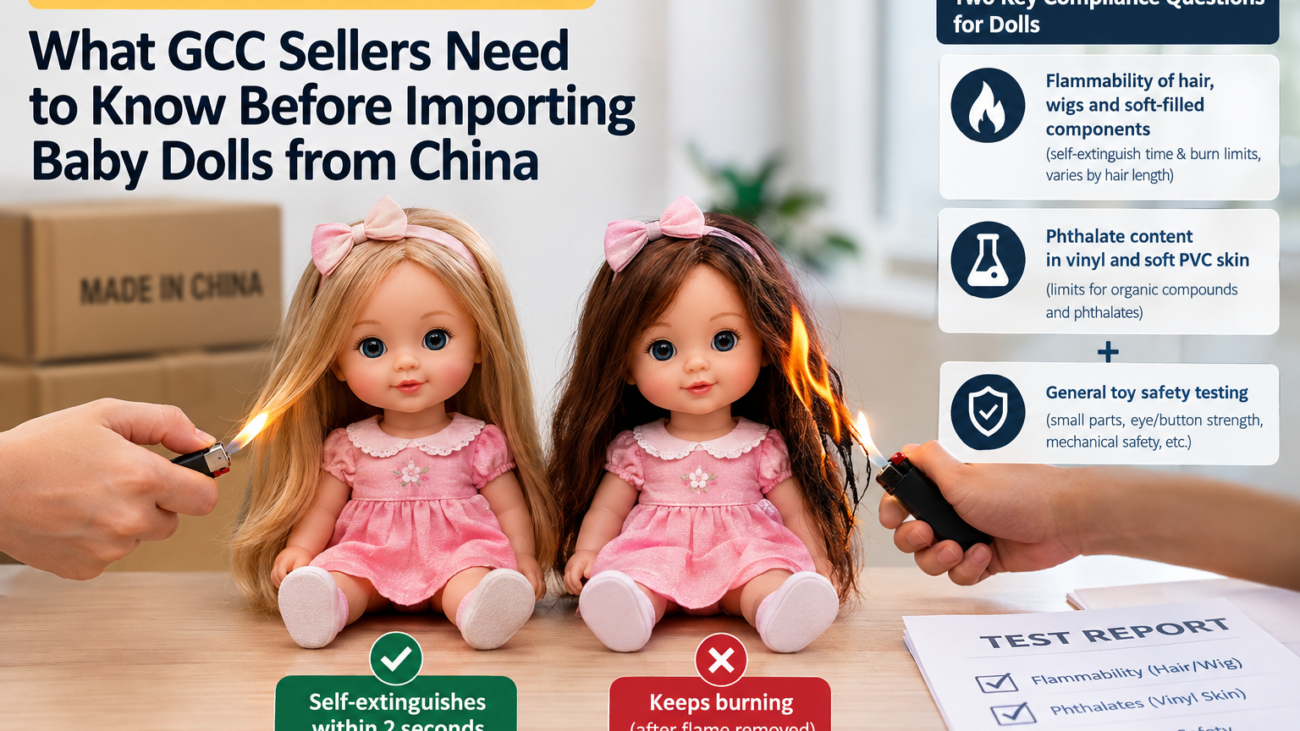
Two dolls sit side by side on a supplier’s sample table. Same face mold, same size, same price per unit. The difference that actually matters — what happens when a small flame touches the hair — isn’t visible in a photo, isn’t mentioned in a WhatsApp product pitch, and usually isn’t tested unless someone specifically asks for it. One doll’s hair self-extinguishes within two seconds of the flame being removed. The other keeps burning. Nothing on the packaging tells a buyer which one they’re getting.
This is the category where the series picks up a hazard type it hasn’t dealt with yet. Ride-on toys were about electrical risk. Feeding products were about chemical migration. Bath toys were about mold and stability. Dolls bring in fire safety — and, layered underneath it, the same skin-contact chemical exposure question we’ve already raised for other categories, applied here to a product that gets hugged and slept with for months at a time.
Why Dolls Carry Two Separate Compliance Questions
Flammability of hair, wigs, and soft-filled components. Dolls fall under the toy safety framework’s specific rules for “soft-filled toys” and materials worn on or attached to the head — the same clause that governs wigs, beards, and headdresses. The actual test is precise: a flame is applied to the hair or pile material and then removed, and the material has to self-extinguish within a defined time limit, with limits on how much of the hair is allowed to burn. Critically, which exact test threshold applies depends on how far the hair protrudes from the doll’s head — a longer, flowing hairstyle is tested differently than a short, close-cropped one. Change the hairstyle, and you can change which test result you actually need.
Phthalate content in vinyl and soft PVC skin. Dolls made from soft, huggable vinyl are held against a child’s skin, carried around, and frequently mouthed by younger siblings even when the doll wasn’t marketed as a teether — which puts the plasticizers used to keep that vinyl soft under the same organic-compound and phthalate limits that already apply to toys generally. This is a variation on ground we’ve covered before, but it’s worth restating here because dolls are one of the longest-duration, closest-contact products in the entire toy category — a child can carry the same doll daily for a year or more.
Both of these sit on top of the general mechanical and structural toy safety testing every doll needs regardless — small parts, eye/button attachment strength, and so on. The hair and the skin are two additional line items, not substitutes for that baseline.
Where Sellers Actually Get Stuck
They get a general toy safety report and assume it covers the hair. A standard toy safety test file often covers mechanical safety and basic material declarations, but flammability testing on rooted or attached hair is frequently a separate line item that has to be specifically requested — and frequently isn’t.
They don’t realize a hairstyle change can change the required test. A factory that supplies the same doll body in three hair lengths may have flammability data for only one of them, because the test threshold shifts with protrusion length. A buyer who picks the “long flowing hair” variant off a catalog photo can end up with a version that was never actually tested to the standard that applies to it.
They treat “flame retardant” as a marketing claim rather than a lab result. It’s an easy phrase for a factory to put in a product description. It’s a much narrower thing to actually prove with a test report.
They don’t retest hair color or fiber changes. A dye lot switch or a change from one synthetic fiber to another can alter burn behavior even when the doll’s overall design stays the same — treated the same way a colorant change should trigger retesting on a feeding product, and just as often skipped.
What Skipping It Actually Costs
Doll flammability failures are rare in absolute terms, but when they do surface — in a customs spot-check, a marketplace compliance request, or worse, an actual incident — they carry a different weight than most compliance misses in this series. Fire-related product safety issues draw a level of scrutiny and reputational damage that a delayed shipment or a bad review simply doesn’t. On the more everyday end, the realistic risk is a marketplace or customs authority asking specifically for the hair’s flammability report, separate from the general toy file — and a seller who only has the general report is caught without an answer, at exactly the moment they need one fastest.
The phthalate side carries the same slower-burning risk this series has flagged before: skin sensitivity complaints or “chemical smell” reviews on a vinyl doll don’t usually show up on day one. They show up weeks into ownership, after the review window has already opened, and they accumulate the same way mold complaints do on bath toys — quietly, and in a pattern that’s hard to trace back to sourcing after the fact.
Building It In Before Production Locks
- Request flammability test results specific to the hair or wig material, not just the general toy safety report — ask for it as its own line item.
- Confirm which protrusion-length test threshold applies to the actual hairstyle you’re ordering, before finalizing that design choice, since a longer or shorter version of the “same” doll can fall under a different requirement.
- Retest on hair color, fiber, or dye lot changes, the same discipline this series has flagged for colorants and material swaps in other categories.
- Keep phthalate and organic-compound testing current on the vinyl skin itself, given how much direct, prolonged skin contact this category involves compared to most other toys.
The Bait Farasha Approach
We treat a doll’s hair and its skin as two separate items in the compliance file, not an afterthought bundled into the face-mold safety report — because that’s genuinely how the testing is structured, whether or not a factory volunteers that distinction upfront. A doll that’s safe to hold and a doll that’s safe near a candle on a birthday cake are two different questions, and we make sure both get answered before a container ships.
If dolls are on your sourcing list for the next cycle, ask us about the hair before you ask about the face — it’s the part almost nobody checks, and the part that matters most.