
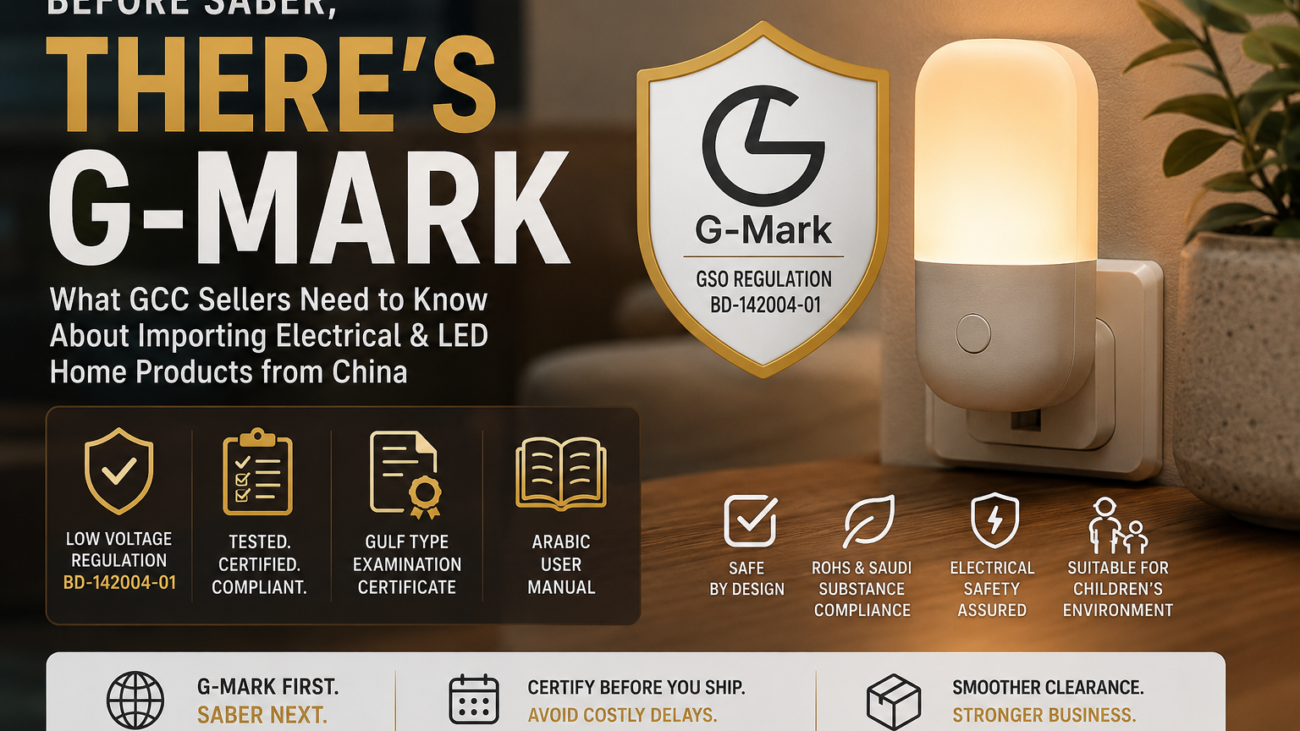
Night lights, LED decor, small electrical fittings — for a seller already sourcing toys or kitchenware, adding electrical home products to the catalog looks like an easy win. No food-contact testing, no small-parts panic, just a plug, a chip, and a light. Demand for this kind of decor is strong on Amazon.sa and Noon, and the margins are usually better than on plastic housewares.
It’s also the category where “we already have SABER sorted” causes the most expensive surprises. Electrical products carry a certificate requirement that has nothing to do with the general SABER process most sellers already know — and until that certificate exists, SABER won’t process the product at all.
That certificate is G-Mark, issued under the Gulf Technical Regulation for Low Voltage Electrical Equipment and Appliances. Toys carry G-Mark too, under their own regulation (BD-131704-01, covered in our SABER post) — but electrical products are certified under a different regulation, with their own testing and their own timeline, and that work has to be planned first. Here’s how it actually works, and where sellers building out an electrical or LED decor line get caught out.
1. The Compliance Layer Most Sellers Miss on Electrical & LED Products
Toys clear Saudi customs under Technical Regulation BD-131704-01. Electrical and LED products — night lights, small appliances, lighting fixtures, anything that plugs in or runs on a battery pack — fall under a different one: BD-142004-01, the Gulf Technical Regulation for Low Voltage Electrical Equipment and Appliances. It covers household appliances, lighting and LED products, and electrical components broadly, whether they’re manufactured locally or imported.
Compliance here runs through G-Mark, listed on the GSO Conformity Tracking System (GCTS). Getting it means a Gulf Type Examination Certificate (GTEC), test reports from an ISO 17025 or ILAC-accredited lab, a full Arabic user manual, and a risk assessment document — one that has to address chemical, physical, mechanical, electrical, and radioactive risk factors, not just whether the wiring is safe.
Where assuming “SABER covers it” fails: G-Mark isn’t a parallel option to SABER — it’s a prerequisite. An electrical product has to be certified and listed on the GCTS before SABER registration will accept it at all. A seller who’s only ever registered toys or kitchenware has never had to touch this system, and a supplier’s claim that something is “CE certified” doesn’t substitute for it — CE is a different regulator entirely.
2. The 4 Most Common Technical Barriers for Electrical & LED Importers
- Not knowing G-Mark exists as a separate step. The single most common gap. Sellers submit an electrical product to SABER the same way they’d submit a kitchen item, and the registration stalls because there’s no G-Mark on file to reference.
- Hazardous substance non-compliance. Saudi Arabia enforces its own restrictions on lead, cadmium, and other substances in electrical and electronic components, similar in spirit to RoHS elsewhere. A factory’s “standard” wiring or solder isn’t automatically compliant with the Saudi list.
- Incomplete risk assessment documentation. A basic electrical safety test isn’t the same as the full risk analysis the regulation asks for. Missing the mechanical or chemical-risk sections of that document is a common reason a G-Mark application gets sent back.
- Extra scrutiny on children’s electrical products. A nursery night light sits in an odd spot — it’s regulated as an electrical product, not a toy, but reviewers and retailers alike look harder at battery access, heat, and small-parts risk on anything clearly designed for a child’s room.
3. How On-the-Ground Sourcing Prevents G-Mark Delays
An electrical product built for one market doesn’t automatically clear another, and a factory quoting “CE ready” is answering a question nobody in Saudi customs is asking. Working with a sourcing partner based in China closes that gap before production even finishes:
- G-Mark sequencing built into the timeline. Certification gets scheduled before SABER submission, not discovered as a missing step after a shipment is already built.
- Component-level substance checks. Wiring, solder, and casing materials get verified against Saudi’s restricted-substance list before a factory locks in its bill of materials.
- Full risk assessment documentation. The chemical, mechanical, and electrical risk sections get prepared alongside the safety test report, not left for a reviewer to flag as missing.
- Notified Body coordination for GTEC. Samples go to labs actually authorized to issue a Gulf Type Examination Certificate, so the result is usable for G-Mark rather than needing to be redone.
Build an Electrical & Decor Catalog That Clears Customs the First Time
A night light or an LED decor piece doesn’t carry the reputational weight of a toy recall, but a shipment stuck behind a missing G-Mark is just as costly — it just shows up as a stalled SABER application instead of a customs hold. The sellers who add this category smoothly are the ones who treat G-Mark as step one, not a surprise at step four.
Ready to add compliant electrical & LED products to your GCC catalog?
Contact Bait Farasha to audit your supplier’s G-Mark documentation or explore our pre-vetted catalog of home decor and electrical products.