
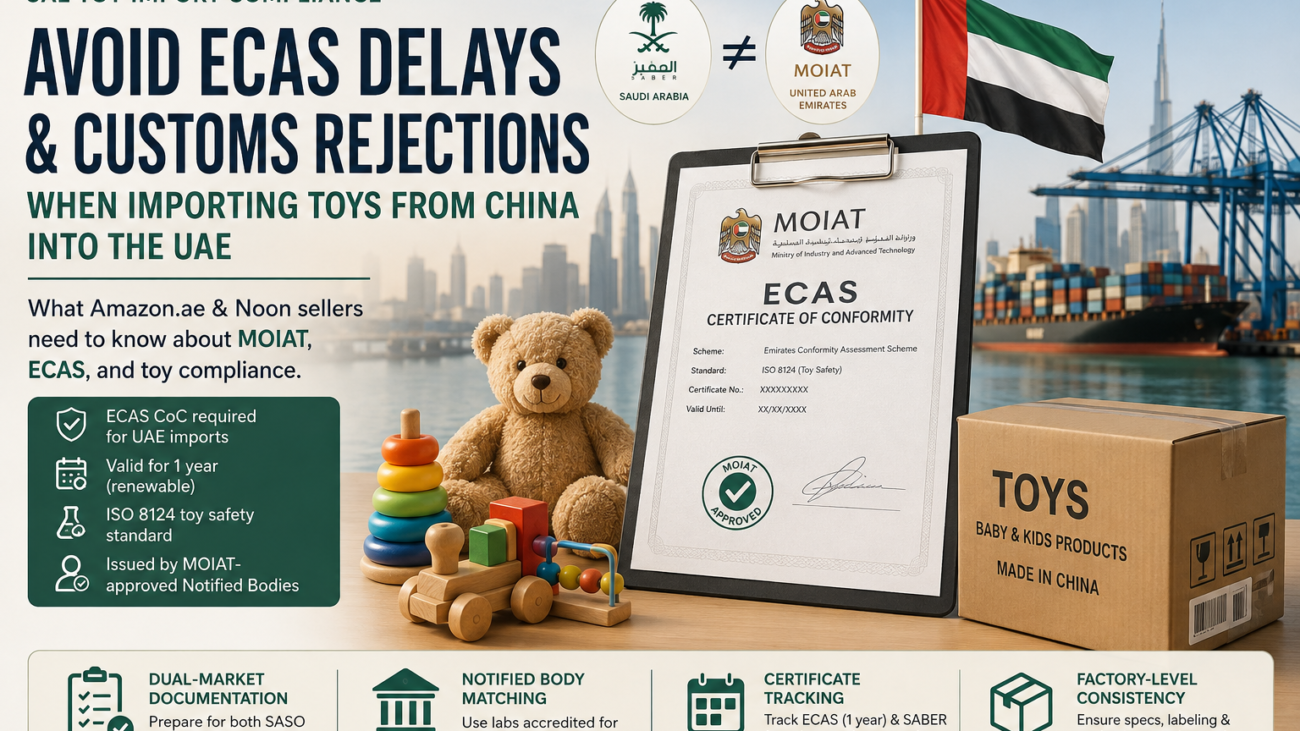
Sellers who’ve already sorted out Saudi SABER compliance often treat the UAE as the easy next step — same region, same product, same paperwork, right? For Amazon.ae and Noon sellers moving baby and kids’ products, the UAE market is large, fast-growing, and sits right alongside Saudi Arabia in most GCC expansion plans.
Except shipments built on that assumption get held at Jebel Ali or Dubai customs anyway — not because the product is unsafe, but because Saudi compliance and UAE compliance run on two entirely separate systems, and a certificate that clears SABER means nothing to UAE customs.
The UAE runs its own certification regime through MOIAT, and it works differently enough from SASO/SABER that treating them as interchangeable is one of the most common — and most expensive — mistakes GCC-focused sellers make. Here’s what actually governs toy and baby product imports into the UAE, and how the right sourcing process handles both markets without duplicating the work twice.
1. The Reality of UAE Compliance for Baby & Kids Products
Where Saudi Arabia runs compliance through SASO and the SABER platform, the UAE runs it through the Ministry of Industry and Advanced Technology (MOIAT) — the body that absorbed the former ESMA (Emirates Authority for Standardization and Metrology) in 2020. If a supplier or freight forwarder mentions “ESMA certification,” they mean the same system; the name changed, the requirement didn’t.
Toys and baby products fall under MOIAT’s Emirates Conformity Assessment Scheme (ECAS), which requires a Certificate of Conformity (CoC) issued by a MOIAT-approved Notified Body — SGS, TÜV Rheinland, and Intertek are the names sellers will see most often. For toy safety specifically, the technical basis is ISO 8124, the international standard covering mechanical and physical safety, flammability, and the migration of certain elements from toy materials.
The structural difference that catches most sellers off guard: Saudi Arabia’s system pairs a product-level PCoC with a per-shipment SCoC, so every shipment needs its own certificate. The UAE’s ECAS CoC is issued at the product level and stays valid for one year, renewable about a month before expiry. That’s a different certificate, on a different renewal calendar, issued by a different set of bodies — not an upgrade of the Saudi paperwork, a parallel one.
Where assuming “GCC compliance” covers both markets fails: A supplier who says a toy is “SABER approved” hasn’t said anything about the UAE. The two systems don’t recognize each other’s certificates, use different Notified Bodies, and in some cases test against different clauses of otherwise-similar standards. Each market needs its own technical file, built from its own test reports.
2. The 4 Most Common Technical Barriers for UAE Toy & Baby Product Importers
- Treating ECAS as a formality once SABER is done. The most expensive assumption in GCC sourcing. A SABER-approved toy still needs its own ECAS CoC, its own Notified Body review, and its own test reports before it can legally enter the UAE.
- Working from outdated ESMA-era guidance. Since the 2020 merger into MOIAT, application portals, document formats, and some technical regulations have been updated. Suppliers and even freight forwarders sometimes still reference the old ESMA process, which can mean submitting the wrong document set.
- Using a lab outside the Notified Body’s accredited scope. A lab can hold broad accreditation without being scoped for the specific test a toy actually requires. MOIAT reviewers check this closely, and a scope mismatch here is one of the more common reasons a technical file gets sent back.
- Inconsistent product details across the file. HS code, product description, and labeling need to match exactly across the CoC application, the invoice, and the packaging — the same discipline SABER demands, just checked by a different reviewer against a different checklist.
3. How On-the-Ground Sourcing Prevents UAE Compliance Failures
A supplier optimized for the Saudi market isn’t automatically ready for the UAE, and vice versa. Working with a sourcing partner based in China who tracks both systems means the same production run can be documented correctly for whichever market — or both — it’s headed to:
- Dual-market documentation from the start. Test reports and technical files are prepared against both SASO/GSO and MOIAT requirements up front, instead of scrambling to redo paperwork when a shipment misses a market it wasn’t built for.
- Notified Body matching. Samples go to labs whose accreditation actually covers ISO 8124 testing for the UAE, not just a general safety accreditation that looks similar on paper.
- Certificate calendar tracking. ECAS renewals are tracked on their own one-year cycle, separate from SABER’s per-shipment cadence, so a catalog doesn’t quietly go out of compliance between orders.
- Factory-level consistency checks. The same product specification, labeling, and packaging are verified before production, so nothing drifts between the batch built for Saudi Arabia and the batch built for the UAE.
Build a Supply Chain That Works Across the Whole GCC, Not Just One Market
Saudi Arabia and the UAE are the two biggest e-commerce markets in the Gulf, and sellers scaling across both need a sourcing process that treats them as two separate compliance tracks rather than one shared checklist. The catalogs that expand fastest are the ones where that distinction gets built in from the first production run, not discovered at a UAE port.
Ready to bring compliant baby & kids’ products into the UAE market?
Message Bait Farasha on WhatsApp to audit your ECAS documentation or ask about sourcing baby and kids’ products for the UAE.