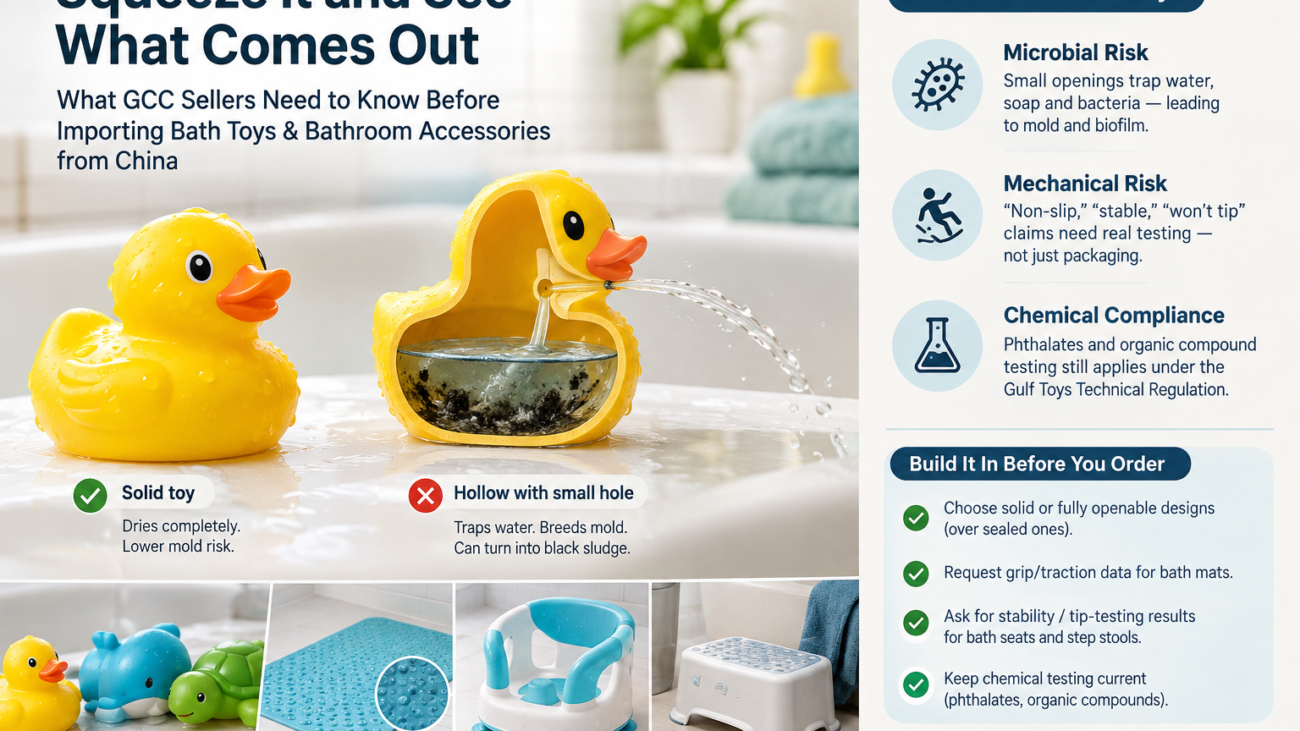
Two rubber ducks can look identical in a supplier’s catalog photo. One is molded solid. The other has a small hole where water squirts out when a baby squeezes it. On paper, they’re the same product category, the same price bracket, sometimes even the same factory. In practice, one of them is a toy. The other is a sealed chamber that fills with warm, soapy water every night and never fully dries — and three to four weeks later, a parent squeezes it and gets a mouthful of black sludge instead of a stream of water.
This is a different kind of compliance problem than the ones we’ve covered so far. It’s not primarily about a certificate you either have or don’t have. It’s about a construction choice made at the design stage, one that most sellers never think to ask about because it isn’t listed as a defect anywhere on the spec sheet.
Why Bathroom Accessories Split Into Two Separate Risks
Baby bath products carry two distinct hazard types, and they need to be evaluated separately:
Microbial risk, driven by construction, not material. Independent research cutting open used bath toys has consistently found dense biofilm — bacteria and mold — growing inside toys with small openings, regardless of the plastic used. The hole that lets a toy squirt water is the same hole that traps a small amount of water inside permanently, and that trapped water, combined with residue from bath soap, is exactly what mold needs to establish itself. A solid toy, or one that can be fully opened and dried, doesn’t have this problem. A sealed one, no matter how “food-grade” or “non-toxic” the material claim on the box, will develop it eventually.
Mechanical risk, tied to physical performance, not paperwork. Bath seats, step stools, and non-slip bath mats are marketed on claims — “non-slip,” “stable,” “won’t tip” — that are printed on packaging, not backed by grip or stability testing in most cases. A mat that looks textured in a product photo can still be genuinely slippery once wet; a bath seat’s actual tip-resistance under a moving toddler is a different question than whether it looks sturdy in a listing image.
Underneath both of these, bath toys are still toys, which means the chemical side of compliance we’ve already covered for other toy categories — phthalate limits and organic compound testing under the Gulf Toys Technical Regulation — still applies in full. This category doesn’t replace that requirement. It adds two more failure points on top of it.
Where Sellers Actually Get Stuck
They choose the cuter design over the safer construction. Squirt toys with small holes are visually appealing and cheap to produce, so they get selected on looks without anyone asking whether the toy can actually be dried out between uses.
They take “non-slip” at face value. A printed claim on a bath mat’s packaging is not the same as a grip or traction test result — and it’s one of the easiest claims for a factory to make without ever having tested it.
They skip stability testing on bath seats entirely, treating them like static furniture rather than a product that has to resist a wriggling, standing, pulling toddler.
They assume premium material solves the mold problem. Switching from PVC to silicone doesn’t help if the toy’s shape still has a sealed cavity that holds water — the mold issue is about geometry, not which plastic was used.
What This Actually Costs — On a Different Timeline Than the Rest of This Series
This is the one category in this series where the risk usually isn’t a container held at customs. Chemical non-compliance and mold-prone construction rarely get caught at the port; they surface weeks or months later, in the customer’s home.
That delay is exactly what makes it dangerous for a listing. A defect that shows up on day one gets refunded and forgotten. A defect that shows up in week four — after the “leave a review” prompt has already gone out — shows up instead as a wave of one- and two-star reviews describing mold, or a bath seat that tipped over, arriving in a steady drip over months rather than all at once. Marketplace algorithms and buyers alike read a slow-building pattern of complaints as a worse signal than a single early return, and it’s much harder to trace back to a sourcing decision once it’s already showing up in your review section.
Building It In Before You Order
- Choose construction, not just material, at the sourcing stage — favor toys that are solid or fully openable for drying over sealed designs with small water-entry holes, regardless of how the material is marketed.
- Request actual grip/traction data for bath mats, not just a “non-slip” claim on the packaging.
- Ask for stability or tip-testing results on bath seats and step stools before committing to a supplier, the same way you’d ask for a lab report on any other safety-critical product.
- Keep chemical testing current regardless of the above — bath toys still fall under standard toy safety testing (phthalates, organic compounds), and passing on construction doesn’t exempt a product from it.
The Bait Farasha Approach
This is a category where we look past the spec sheet at the product itself — whether a toy’s shape lets it actually dry out, whether a “non-slip” mat has anything behind that claim, whether a bath seat has been tested under real conditions rather than just photographed on a store shelf. Chemical compliance is table stakes; construction is where this category is actually won or lost.
If bath toys or bathroom accessories are part of your next order, talk to us about construction before you talk about price — it’s the difference between a product that lasts a bath season and one that comes back as a review nobody wants to read.