
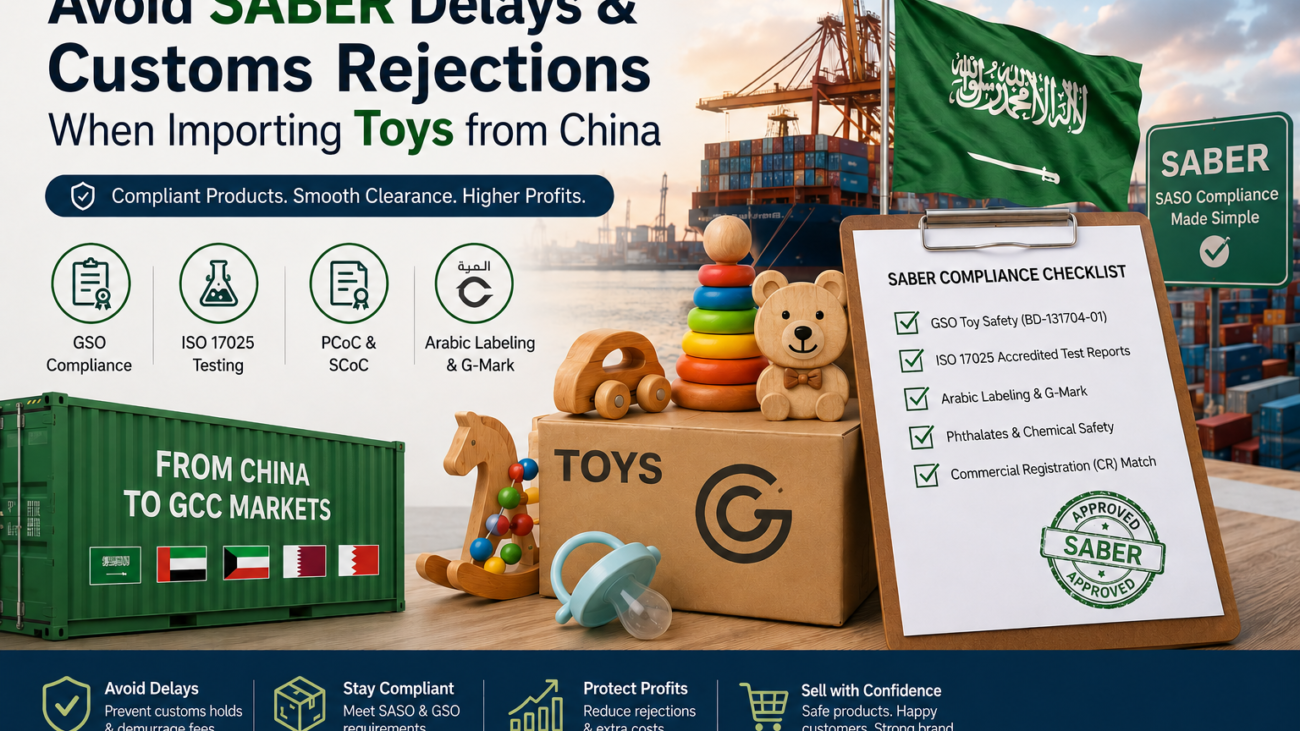
For e-commerce sellers on Amazon.sa, Noon, and regional GCC marketplaces, scaling a catalog of baby and kids’ products from China should be simple. Demand across Saudi Arabia and the Gulf is high, margins on wooden toys and baby gear are healthy, and Chinese manufacturing infrastructure is unmatched.
Yet, every week, shipments sit impounded at King Abdulaziz Port in Dammam or King Khalid International Airport in Riyadh.
The issue isn’t product quality—it’s compliance mapping. Importing regulated items into Saudi Arabia requires precise adherence to SASO (Saudi Standards, Metrology and Quality Organization) rules and the SABER platform. For importers sourcing directly via online chat folders or unverified suppliers, one missing document can result in hefty demurrage fees, rejected customs entries, or total shipment destruction.
Here is how smart GCC e-commerce sellers navigate SABER compliance when importing toys and baby products from China—and how on-the-ground support eliminates supply chain friction.
1. The Reality of SABER Compliance in Saudi Arabia
SABER is an online portal launched by SASO to register and issue Conformity Certificates for imported goods entering Saudi Arabia. For toys and baby products, compliance is enforced stringently:
-
PCoC (Product Conformity Certificate): Valid for 1 year. This proves your product model complies with relevant GSO (GCC Standardization Organization) technical regulations (such as BD-131704-01 for toy safety).
-
SCoC (Shipment Conformity Certificate): Required for every single commercial container or air freight shipment entering the Kingdom. It cannot be issued without an active PCoC.
Where direct factory sourcing fails: Most factories on Chinese supplier platforms will claim they are “certified for Saudi Arabia.” What they usually mean is they passed a generic European test (like basic CE) years ago. When customs asks for laboratory test reports from an ISO 17025-accredited body explicitly aligned with GSO standards, unvetted suppliers often fail to produce them, leaving the Saudi importer stranded.
2. The 4 Most Common Technical Barriers for GCC Importers
When sourcing Montessori toys, nursery accessories, and feeding gear, four major documentation and physical test gaps lead to customs rejections:
-
GSO Toy Technical Regulation (BD-131704-01): Requires physical tests for mechanical integrity (sharp edges, small parts choke hazards), flammability, and heavy metals transfer (migration of 19 toxic elements).
-
Arabic Labeling & GCC Conformity Marking (G-Mark): Physical products and retail packaging must feature the G-Mark logo, safety warnings in clear Arabic, and traceable importer/manufacturer credentials. Sticker overlays applied haphazardly at the port are frequently rejected.
-
Phthalates & Chemical Safety: Soft plastics, silicone feeding sets, and bath toys must be certified free of restricted plasticizers (DEHP, DBP, BBP, DINP) and BPA.
-
Commercial Registration (CR) Alignment: The SABER PCoC must be applied for using the Saudi commercial registration holder’s account. Discrepancies between the HS Code, invoice descriptions, and SABER entries immediately trigger customs holds.
3. How On-the-Ground Sourcing Prevents Logistics Failure
A factory’s core objective is to ship units out of their factory gate; a sourcing partner’s job is to ensure those units clear Saudi customs and sell smoothly.
Working with an on-the-ground team in China bridges the gap between Chinese factory floors and GCC regulatory standards:
-
Pre-Production Document Audits: We inspect a factory’s test reports before you pay a deposit. If their EN71 or GSO certificates are outdated, incomplete, or issued by unaccredited labs, we flag it immediately.
-
Factory-Level Sample Physical Testing: Samples are pulled directly from the production line—not hand-picked “golden samples”—to verify build quality, paint non-toxicity, and mechanical durability.
-
Correct Packaging at the Source: We mandate that packaging artwork includes correct Arabic safety warnings, G-Mark placement, and required barcodes during printing in China, eliminating costly re-labeling in Middle Eastern warehouses.
-
Coordination with SASO-Notified Bodies: We work alongside accredited inspection bodies in China to streamline physical container inspections and facilitate smooth SCoC issuance before your freight leaves port.
Build a Compliant, High-Margin Supply Chain
Navigating Saudi customs regulations shouldn’t prevent you from growing your e-commerce brand. By establishing clear compliance controls in China before goods are manufactured, GCC sellers protect their margins, maintain account health on platforms like Amazon.sa and Noon, and build long-term customer trust.
Need compliant, market-ready baby & kids’ products for your GCC store?
Message Bait Farasha on WhatsApp to audit your supplier documentation or explore our pre-vetted catalog of Montessori, feeding, and nursery products.