
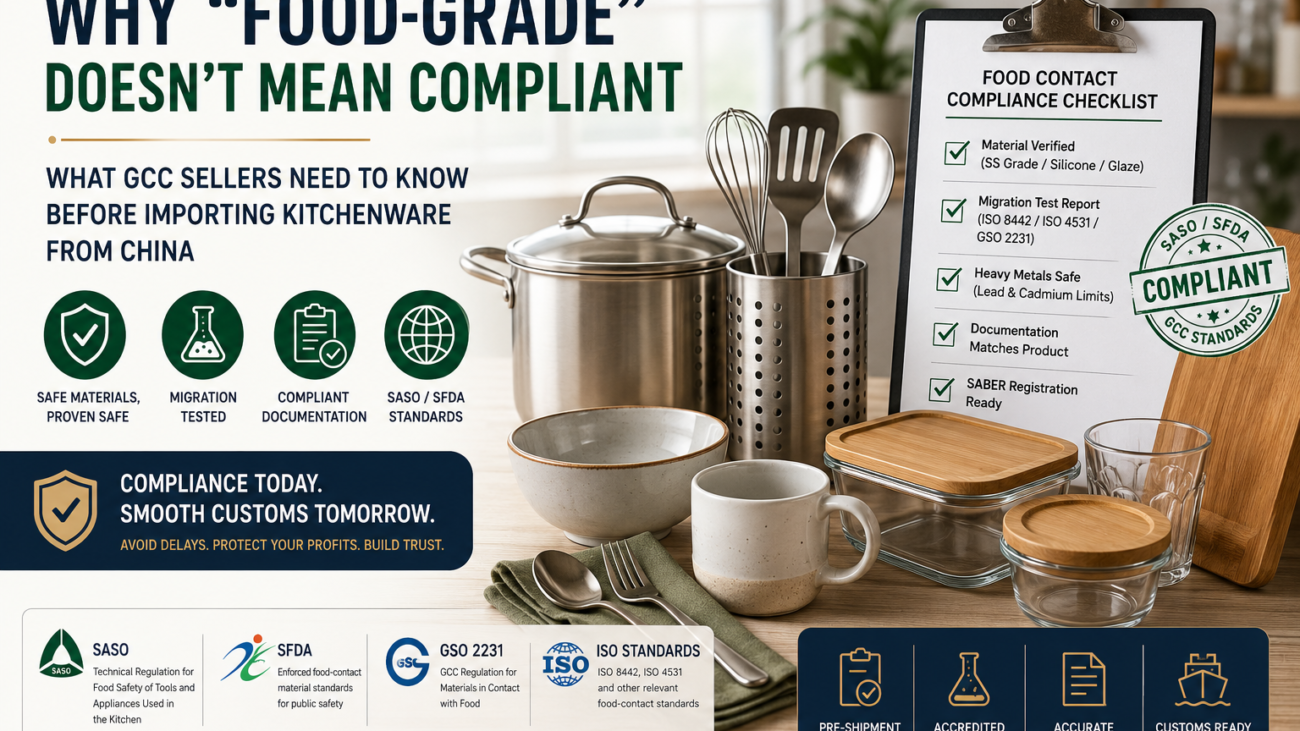
Most SABER-registered importers know the general shape of Saudi product compliance: a Product Certificate of Conformity, a Shipment Certificate of Conformity, and a technical regulation sitting behind both. What’s less well known is that kitchenware carries an additional, more specific layer on top of that.
1. The Extra Compliance Layer on Kitchenware
Saudi Arabia enforces it through the SASO Technical Regulation for Food Safety of Tools and Appliances Used in the Kitchen, which applies to anything that touches food during storage, preparation, or serving — cookware, tableware, storage containers, drinkware, and utensils alike. Article 4 is the operative clause: it sets migration limits so that whatever a product is made of can’t leach into the food it holds.
Running alongside it is GSO 2231/2012, the GCC-wide regulation covering any material intended to come into contact with food, plus GSO 839 and GSO 1863 for food packaging specifically. And where SASO/SABER issues the import certificate itself, it’s the Saudi Food and Drug Authority (SFDA) that owns and enforces the underlying food-contact-material standards — a second regulator most first-time kitchenware importers never think to check.
Where direct factory sourcing fails: Ask a Chinese kitchenware supplier if their product is “food grade,” and almost every one will say yes. Food grade isn’t a certification — it’s a marketing term. What SFDA and customs actually require is a migration test report from an accredited lab, run against the standard that matches the material: ISO 8442 for tableware and cutting tools, ISO 4531 for lead and cadmium emission from glass and porcelain glazes, GSO 2231 for food-contact materials generally. A supplier’s word that something is food grade satisfies none of these.
2. The 4 Most Common Technical Barriers for GCC Kitchenware Importers
- Stainless steel grade substitution. 304 and 201 stainless steel look identical, weigh about the same, and cost noticeably different amounts to produce. 201 carries less nickel and chromium, corrodes faster, and isn’t meant for prolonged food contact — but it’s routinely sold as 304 on B2B platforms unless a buyer requests spectrometer (XRF) testing to confirm the actual alloy.
- Glaze and paint heavy metals. Ceramic and glass items — herb jars, mugs, decorative tableware — fall under SASO-ISO 4531 for lead and cadmium leaching from painted or glazed surfaces. The most decorative, eye-catching glazes are often exactly the ones most likely to fail this test, and there’s no way to tell by looking.
- Silicone filler dilution. Genuine food-grade silicone isn’t cheap. Some manufacturers cut it with fillers or lower-grade compounds to hit a price target — the finished product looks and feels normal, but fails migration and odor testing.
- Documentation that doesn’t match the material. As with any SABER-registered product, the HS code, invoice description, and certificate need to align exactly — but for kitchenware, the test report also has to reference the correct standard for the correct material. A stainless-steel bottle and a melamine tableware set are tested under entirely different clauses, and a generic “food safe” report for the wrong material won’t clear customs.
3. How On-the-Ground Sourcing Prevents Kitchenware Compliance Failures
A factory’s incentive is to ship product. A sourcing partner’s job is to make sure that product clears customs and holds up once it’s actually in a customer’s kitchen. Working with a team based in China closes the gap between what a factory claims and what SFDA and SASO actually require:
- Material verification before deposit. Alloy composition, glaze safety, and silicone grade get checked before payment goes out — not after a shipment is already built.
- Migration testing against the right standard. Samples go to accredited labs for the specific test that applies — ISO 4531 for a glazed ceramic jar, ISO 8442 for a stainless tableware set, and so on.
- Documentation matched to the product. Test reports, HS codes, and SABER entries get aligned to the exact material and product type before goods leave the factory, not reconciled after a customs hold.
- Coordination with accredited labs in China. We work directly with labs recognized for GSO and SFDA-aligned testing, so results hold up for SABER registration instead of needing to be redone once goods reach Saudi Arabia.
Build a Compliant, High-Margin Kitchen Catalog
Kitchenware doesn’t carry the reputational risk of a toy recall, but a customs hold or a failed migration test is just as costly to a growing catalog — in demurrage, in delayed listings, and in account standing on Amazon.sa or Noon. The sellers who scale this category fastest are the ones who treat “food grade” as a claim to verify, not a box that’s already checked.
Need compliant, market-ready kitchenware for your GCC store?
Contact Bait Farasha to audit your supplier’s material documentation or explore our pre-vetted catalog of cooking tools, drinkware, and kitchen storage.