
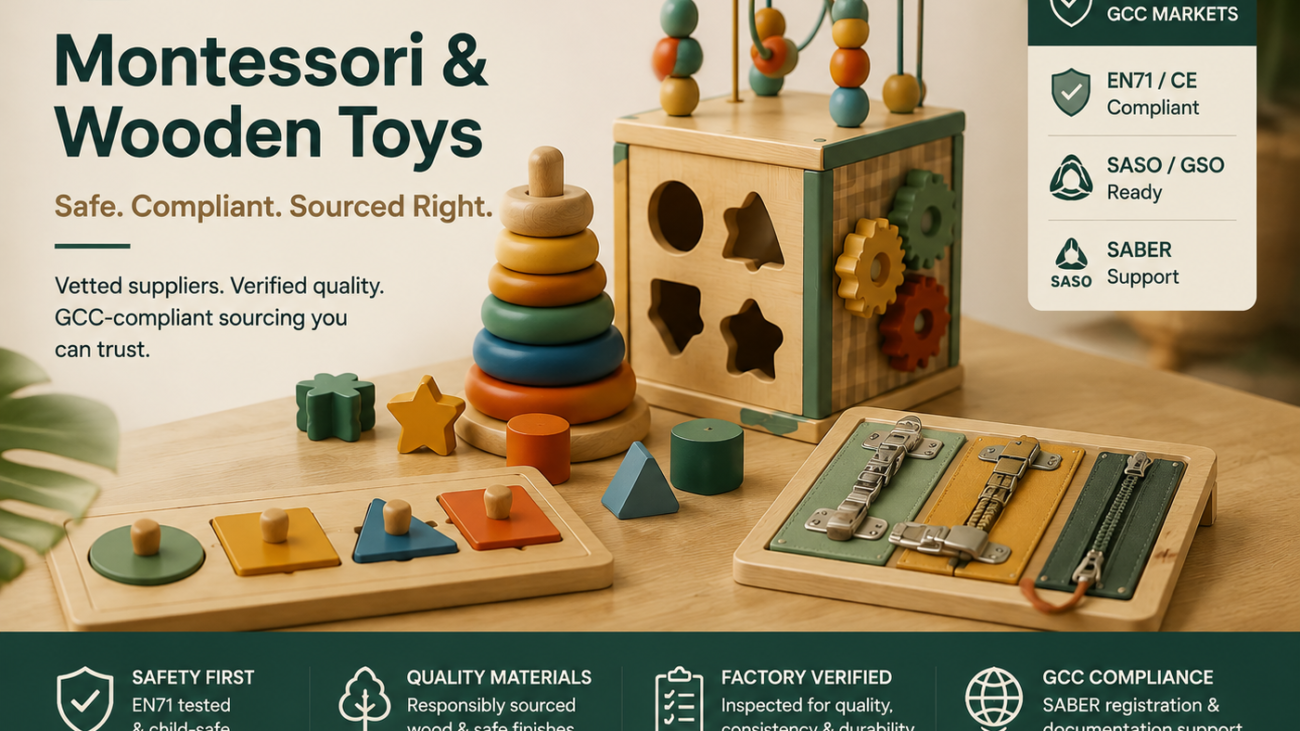
A closer look at one of the fastest-moving categories on Amazon.sa — and why finding a factory is the easy part.
Montessori and wooden toys are one of the strongest-performing categories in GCC baby and kids e-commerce right now. Screen-free, developmental play has real pull with GCC parents, and sorting toys, activity cubes, busy boards, and learning puzzles consistently rank among the top movers on Amazon.sa and in boutique storefronts across Riyadh, Jeddah, and Dubai.
That demand is exactly why so many buyers try to source this category on their own — and why so many of them get burned. Wood-based toys look simple to vet from a product photo. In practice, this is one of the categories where the gap between “looks fine in the listing” and “actually safe and durable” is widest, and where a sourcing partner earns its keep the most.
Why Wooden Toys Are Harder to Vet Than They Look
A metal or plastic product’s quality issues tend to show up in obvious ways — a crack, a broken hinge. Wood is different. The problems that matter most in this category are often invisible in a product photo and only surface after a shipment has already landed:
- Finish and coating safety. Non-toxic, child-safe finishes are the entire point of a wooden toy, but “non-toxic” claims from a factory are worth exactly as much as the documentation behind them. Without material safety paperwork checked before a bulk order, a buyer has no way to confirm what’s actually on the wood their customer’s toddler will chew on.
- Wood sourcing and consistency. Responsibly sourced wood isn’t just a sustainability line — it affects grain quality, splinter risk, and how consistently a factory can reproduce the same product run after run. A first sample can look great and still come from a supplier who can’t hold that standard at volume.
- Small-parts and choking-hazard geometry. Sorting toys and puzzles are built around small, separable pieces by design. Getting the dimensions and edge tolerances right against EN71 small-parts requirements is a detail that’s easy for an unverified factory to get wrong and hard for a buyer overseas to catch from a spec sheet.
- Joinery and fastening durability. Busy boards and activity cubes combine multiple moving parts — knobs, latches, sliders. Loose joinery doesn’t always show up in a first sample; it shows up after a few hundred uses, which is exactly when a buyer can least afford to find out.
What We Check Before a Montessori Supplier Enters Our Network
This is where a sourcing partner’s job actually happens — not in the outreach, but in the screening a buyer would otherwise have to do themselves, from another country, without being able to walk the factory floor.
- Documentation first. We ask for material safety and finish documentation before requesting samples, not after. A supplier who can’t produce it promptly is a signal, not a formality.
- Physical sample inspection. Every sample is checked against EN71 small-parts and safety benchmarks, with particular attention to edge finishing, joint strength, and coating adhesion — the details that don’t show up in a photo.
- Production consistency checks. We look at a supplier’s track record across previous runs, not just their best sample, since the gap between a hand-finished sample and a factory’s actual output is where most quality complaints originate.
- Compliance mapping to destination. Montessori and wooden toys sold into the GCC still need to clear EN71/CE benchmarks and SASO/GSO and SABER requirements on the Saudi side — and SABER registration sits with the Saudi CR holder, so we coordinate with buyers directly to make sure that paperwork is lined up before goods ship, not after they’re stuck at port.
Where a supplier falls short on any of this, they don’t move into our sourcing pool — no matter how good the sample photos look or how attractive the price point is.
The Real Cost of Sourcing This Category Alone
The buyers who get hurt worst in this category aren’t the ones who skip sourcing altogether — they’re the ones who source directly from a factory they found through a marketplace listing, get a great-looking sample, and place a bulk order on the strength of that one sample. The finish issue, the small-parts tolerance problem, or the joinery weakness that a proper inspection would have caught shows up instead in customer returns, a SABER compliance snag, or a listing suspension — all of it far more expensive than the sourcing work would have been upfront.
That’s the gap Bait Farasha is built to close: we do the factory-floor verification a GCC-based buyer can’t do from overseas, so that by the time a Montessori or wooden toy product reaches your catalog, the documentation, the sample, and the supplier’s track record have already been checked.
Ready to Add Montessori & Wooden Toys to Your Catalog?
Whether you’re a Riyadh boutique looking for a signature wooden toy line or an Amazon.sa seller expanding into developmental play, Bait Farasha gives you a vetted, compliant path into this category — without needing to verify a Chinese factory yourself.
Get in touch with our team to talk through what’s selling in this category right now and how we can bring it into your catalog safely.